
Research article · Theory and predictionPublished
Partly, and the part that failed is the instructive one. A theory with no adjustable parameter predicted, before anything was computed, how much open future fifty-six agents would buy with their energy. Where the agents’ traveller moves at the world’s own pace, all 32 predictions landed within a third of a percent, at new temperatures and with a longer view of the future. Where the traveller moves four or sixteen times faster, the theory still got every pattern right, but its numbers fell short by up to 8.8%. Aim keeps more of its value at speed than the theory expects, and that points at what the theory leaves out.
From measurements to a theory
How Much Open Future Can a Unit of Energy Buy? and Does Seeing Further Ahead Buy More Open Future? measured, exactly, what an agent’s energy buys in small archipelagos. Exact answers have a price: a world of five islands already has ten thousand states, and a world of twenty would need more than any computer can enumerate. The questions that matter for agency live at larger sizes.
A theory can go there. But a theory that fits data it was built from proves little. It has to predict.
The theory in one paragraph
Each bridge is a coin that the weather and the fuel keep flipping, and the traveller walks across the bridges that stand. Given where the traveller has been, each bridge’s chance of standing evolves exactly. The theory keeps that exact for one bridge at a time, together with the traveller. It replaces every other bridge by its average chance of standing, given where the traveller is. Nothing is fitted. Built after the last experiment, it reproduced all 48 of its measured edges within 0.62%.
What it says
The theory explains the earlier results with two simple facts.
A bridge is worth most where the traveller stands. In the earlier worlds, counting two steps out, an extra bridge at the traveller’s island opens six to fifteen times as much future as one elsewhere. And a bridge forgets: the weather undoes it four to nine times faster than the traveller can step. So fuel spent on bridges further along a route chosen at random decays before the traveller arrives. That is why foresight about a blind plan never paid.
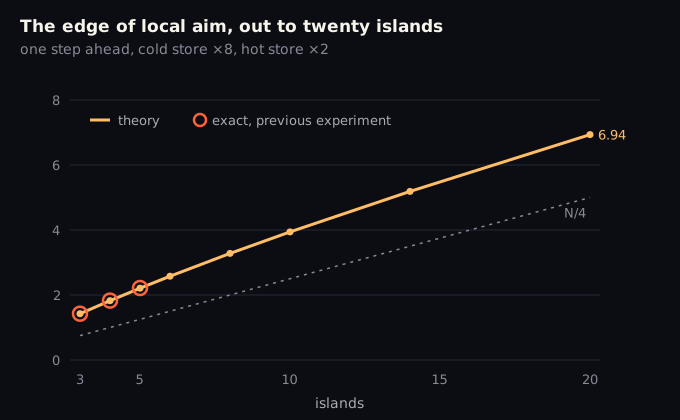
Aim grows with the world. Random spending spreads its bridges over every pair of islands, while the traveller can use only those around it. The edge of fuel spent where the traveller stands follows a simple law. It grows without limit, approaching a quarter of the number of islands.
The test
Fifty-six predictions were written down to six decimals and fixed with a digital fingerprint before any of their worlds was solved. The worlds were new in at least one way:
- two new pairs of stores, one cold store multiplying by 5 and one by 12;
- travellers four and sixteen times faster than before;
- the open future counted three steps out instead of two.
Five claims were at stake:
- Numbers: every edge within 1% of its frozen prediction.
- Speed: faster travellers gain less from aim.
- Blind foresight: each further step of aim along a randomly chosen route lowers the edge.
- The nearest aim leads: fuel on the bridges the traveller may cross next beats fuel on all of its bridges.
- The law: the one-line formula over-predicts the edge of local aim by at most 3%.
Where the numbers held
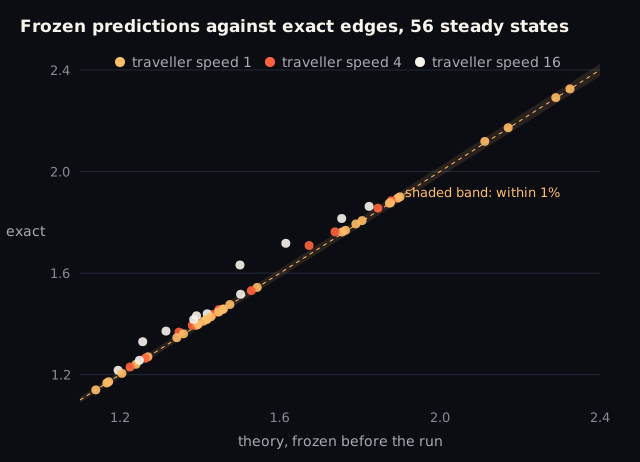
At the traveller’s normal pace, every one of the 32 predictions held. The largest error was 0.36% and the average 0.10%. That covers temperatures the theory had never seen and a measure of the future it had never been checked against.
Where they failed
As the traveller speeds up, the points leave the diagonal, always upward. At four times the pace, 3 of 12 edges fell outside 1%, the largest by 2.1%. At sixteen times, 11 of 12 did, the largest by 8.8%. The first claim, numbers within 1% everywhere, is refuted.
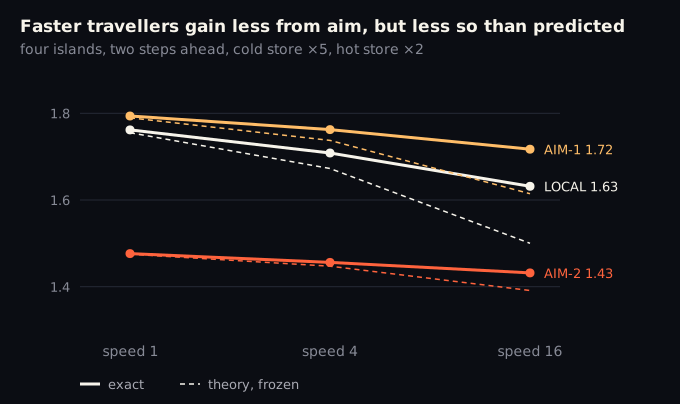
The shape survived intact. Faster travellers did gain less from aim, in all twelve cases, but the loss is smaller than the theory says. Every further step of blind aim lowered the edge, in all fourteen worlds where it could. The nearest aim led in all twenty. And the one-line law stayed within 3% in all six of its worlds.
What the miss tells us
The theory treats each bridge exactly and sees all the others only on average. A slow traveller sees one bridge at a time, and that is enough. A fast traveller ends up wherever the standing bridges let it go. Where it is then says something about several bridges at once, and fuel spent there lands where those bridges stand together.
The likely missing ingredient is these joint correlations, which a theory built from single bridges cannot hold. The error always has the same sign, grows with speed, and is larger in the warmer world, where more bridges stand at once. All of that fits. A first check after the run supports this reading. Keeping pairs of bridges exact, instead of one, halves the error at sixteen times the pace in the three-island worlds, and narrows it by a quarter with four islands, where more than two bridges move together. The theory now has a direction to grow in, and each step will be tested the same way: in advance, on numbers nobody has computed.
How we know
The experiment followed the protocol of the four before it, with the theory itself frozen first.
- The theory, frozen. The theory’s code and its 56 predictions were committed with digital fingerprints before the experiment was drafted.
- Preregistration. The worlds, the five claims, twelve acceptance tests, and nine deliberately broken worlds were frozen after two rounds of independent review. No exact result for any of these agents was computed by the designer or the referee before the run.
- Embargoed build. A dependency-free Rust verifier reused, unchanged, the exact arithmetic of the previous two experiments. It checks its copy of the theory against the frozen fingerprint.
- Three reviews of the exact code, each approving the same commit without running it.
- One run. All twelve tests passed in all twenty worlds, for 76 exact steady states in fifteen minutes.
- An independent check. A separate Python program, written from the preregistration alone, agrees with the recorded run on every value and every verdict.
The broken worlds failed exactly where they were predicted to, including two new ones:
| Broken world | Where it failed first |
|---|---|
| Slow replanning: the traveller replans at the old pace while it walks at the new one | The rule check, on the empty archipelago |
| Corrupted theory: one digit of one prediction changed | The theory’s fingerprint |
| One-way fuel, free protection, equal stores, biased step, aim off by one, wrong calibration, wrong rival | Where each failed in the previous experiment |
What it means
A theory of what an agent’s energy buys now exists that predicts, rather than fits, inside a clearly marked regime. When the agent moves at the pace of the world it shapes, the theory’s numbers can be trusted to a third of a percent. That makes it a tool for worlds far larger than exact methods can reach, and in those worlds aim keeps gaining with every island.
I believe this is how a physics of agency has to grow. Exact experiments small enough to be certain are paired with a theory precise enough to be wrong, and each failure is turned into the next ingredient. The theory’s two clearest statements both point the same way. A fast agent’s position carries information about its world, and blind plans buy nothing. The next experiments give the traveller plans that carry information, and they count the price of that information in the same store as everything else. The five formulas of this programme, and how sure we are of each, are collected on one sheet.
Read, inspect, reproduce
Read: the evidence guide explains every file.
Inspect: the theory with its code and frozen predictions; the preregistered boundary; and the result record, with every prediction set against its exact value and the complete report.
Run: the verifier source is a dependency-free Rust crate. Following the run guide, from the crate’s folder:
cargo test --release --locked
cargo run --release --locked --quiet
The run takes about fifteen minutes. The 104-line report ends with the five verdicts and OVERALL PASS. The independent check needs only Python. The same experiment is in the Xyphers repository.
Research trail
- J. M. Horowitz, K. Zhou, and J. L. England, “Minimum energetic cost to maintain a target nonequilibrium state”, Physical Review E 95, 042102 (2017): the price floor under every agent here.
- A. D. Wissner-Gross and C. E. Freer, “Causal Entropic Forces”, Physical Review Letters 110, 168702 (2013): the push toward open futures.
- K. Takahashi and Y. Hayashi, “Thermodynamic limits of physical intelligence”, Artificial General Intelligence (AGI 2026), Lecture Notes in Computer Science, 339 (2026): empowerment per joule, the closest earlier measure.
- Xyphers research, “How Much Open Future Can a Unit of Energy Buy?” and “Does Seeing Further Ahead Buy More Open Future?”: the experiments the theory explains.